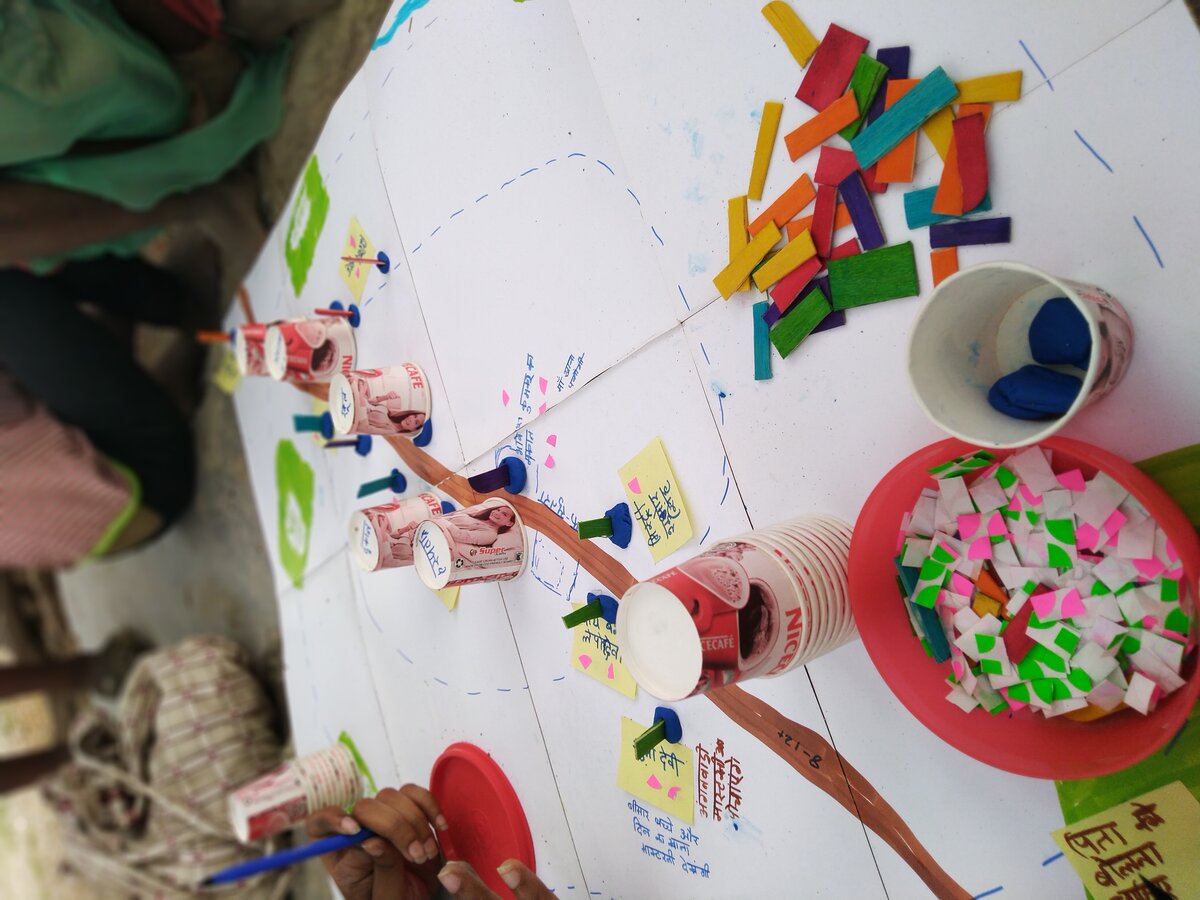
In 2019, working with Project Potential Trust in Kishanganj, rural Bihar, we ran a participatory research project on how caste shapes education and village life. We worked mostly in Bhutijhari, where caste sorts the settlement plainly, and its neighbouring Adivasi settlement of Bhelatupi.
Project Context
We chose Bhutijhari with Project Potential, and included Bhelatupi nearby, because the contrast between the two shows how caste plays out in where people live and how children get to school.
Initial Mapping Activity
We used a map to start structured discussions with Project Potential’s local researchers, who shared their own observations and experiences of caste. Bhutijhari’s houses run along caste lines; Bhelatupi’s are mixed clusters. The map made that contrast easy to talk about.
Working with local researchers
The local researchers were mostly youth volunteers from Project Potential, and since they would still be there after we left, we worked with them as facilitators rather than subjects. We spent time on team-building first and shared some basic design-thinking tools.
One activity they ran, “Mummy kya Bolengi? kya Bolenge?”, looked at how beliefs pass from parents to children. Through storytelling and role-play, people voiced the myths and warnings that carry caste from one generation to the next.
Speculating an Ideal Village
We also asked adults and children to build an ideal village on a hand-drawn map, placing homes and infrastructure by occupation. Occupation stands in for caste here, so where people put things, and what they put first, showed how differently the two communities see the same village.
Reflections
The point was less to produce findings than to make caste discussable on the ground, in a form people could point at and argue with, rather than in academic language. It is a small piece of work, and it mostly taught us where the real questions are.